Bright Does Not Mean Visible: What Drivers Actually See at Dusk

Quick Answer: Bright colours work in daylight and stop working at dusk, when colour perception fades and everything reads as grey. What actually makes you visible in low light is retroreflective material on moving parts - ankles, wrists, knees - because motion is what the human eye detects first. Fluorescent colours help at dawn and dusk specifically; reflectivity is what matters after dark.
As the evenings pull in through late August and September, a lot of people reach for their brightest kit and assume the job is done. It is a reasonable assumption and it is wrong in a specific, useful way.
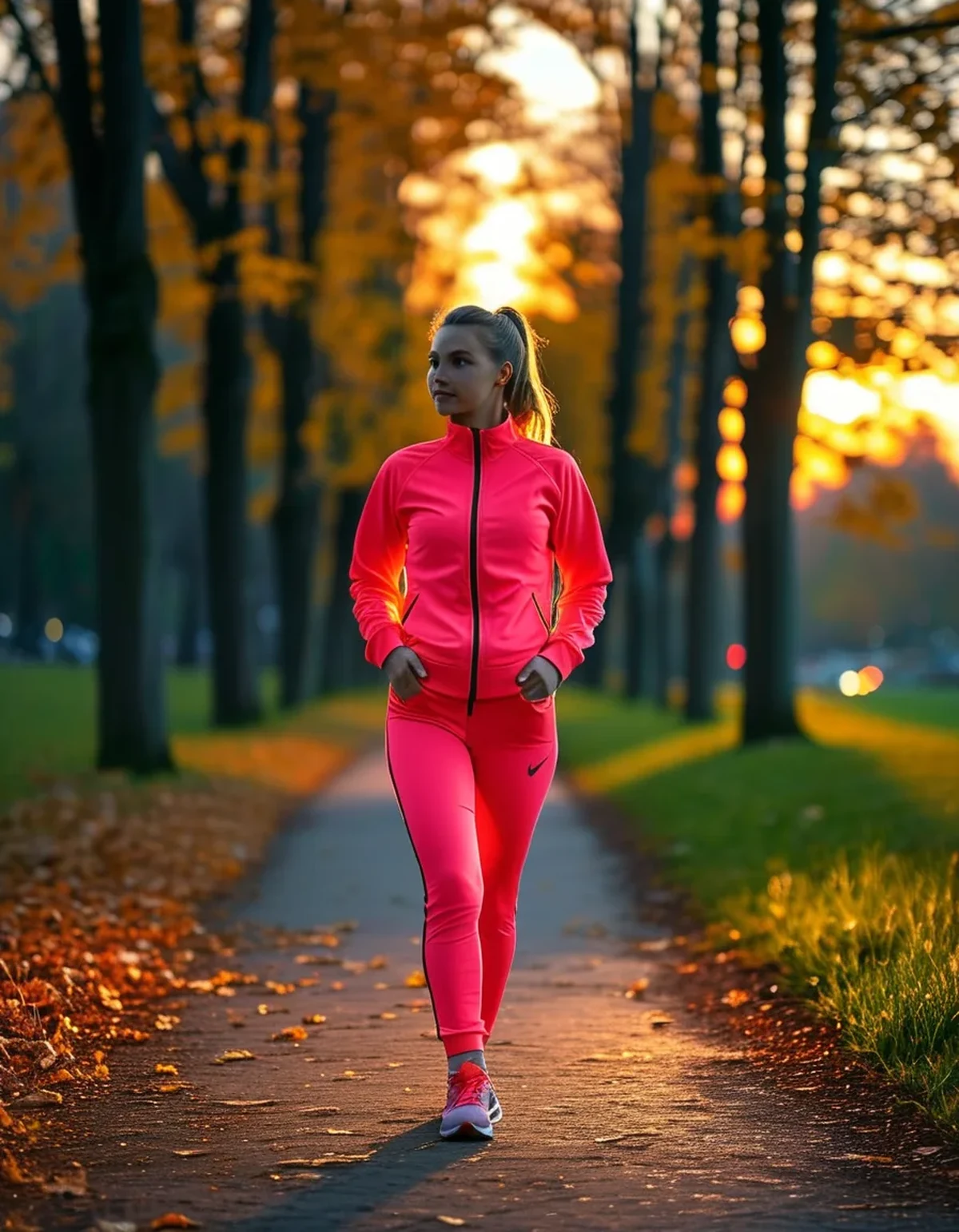
Why does bright clothing stop working at dusk?
Because of how human vision changes as light drops, and the change is more abrupt than most people realise.
Your eye has two systems. Cone cells handle colour and detail and need reasonable light. Rod cells handle low light and are essentially colourblind. As light fades, vision shifts from cone-dominant to rod-dominant - and in that shift, colour perception largely disappears.
The practical consequence: at twilight, a neon pink top and a mid-grey top look far more similar to a driver than they do to you in a lit room. The brightness advantage collapses at exactly the hour when most people are out walking or running.
There is a middle stage worth knowing about - mesopic vision, where both systems are partly active. Under these conditions the eye’s peak sensitivity shifts toward the blue-green part of the spectrum. This is why yellow-green fluorescent is the standard for high-visibility workwear, and why it outperforms orange and red in twilight specifically.
What fluorescent actually does: fluorescent dyes absorb ultraviolet light and re-emit it as visible light, which makes them appear to glow. They require UV to work, so they perform brilliantly on overcast days and at dawn and dusk, and do essentially nothing after full dark. The glow you get at 7pm in September is genuine. The glow at 9pm is not there at all.
And the point people miss most: a driver at 60km/h covers a lot of ground in the second or two it takes to identify what they are seeing. The question is not whether you are visible but how early you are identifiable as a person.
What actually makes you visible in the dark
Retroreflective material, positioned on the parts of you that move.
How retroreflection differs from being bright: retroreflective material sends light back toward its source rather than scattering it. Headlights hit it, and the light returns to the driver’s eyes. It is enormously more effective than any colour after dark - reflective material can be visible at several hundred metres where dark clothing is visible at perhaps 30.
Placement matters more than quantity, and this is the part that is genuinely counterintuitive:
- Ankles, wrists, and knees beat the torso. The eye and brain detect biological motion - the distinctive pattern of a walking or running human - remarkably fast. Reflective strips on moving limbs are identified as a person far sooner than a reflective vest, which reads as an ambiguous bright shape.
- This effect has a name in the research literature: biomotion. Studies comparing reflective vests against limb-mounted reflective markers consistently find the limb configuration is recognised at significantly greater distances.
- Shoes with reflective detail are quietly excellent, because feet move through the largest range at the lowest point in a driver’s field of view.
A practical hierarchy for after dark:
- Best: reflective ankle bands and wrist bands, plus a light
- Very good: reflective detail on shoes and leggings at the calf
- Good: a reflective vest or jacket with limb detail
- Limited: a reflective vest alone
- Almost nothing: bright colours alone
Active lights beat passive reflection in some conditions, particularly where there are no headlights to reflect - unlit paths, parks, and towpaths. A small blinking light front and rear costs very little and is visible from far further than reflection where there is nothing to reflect.
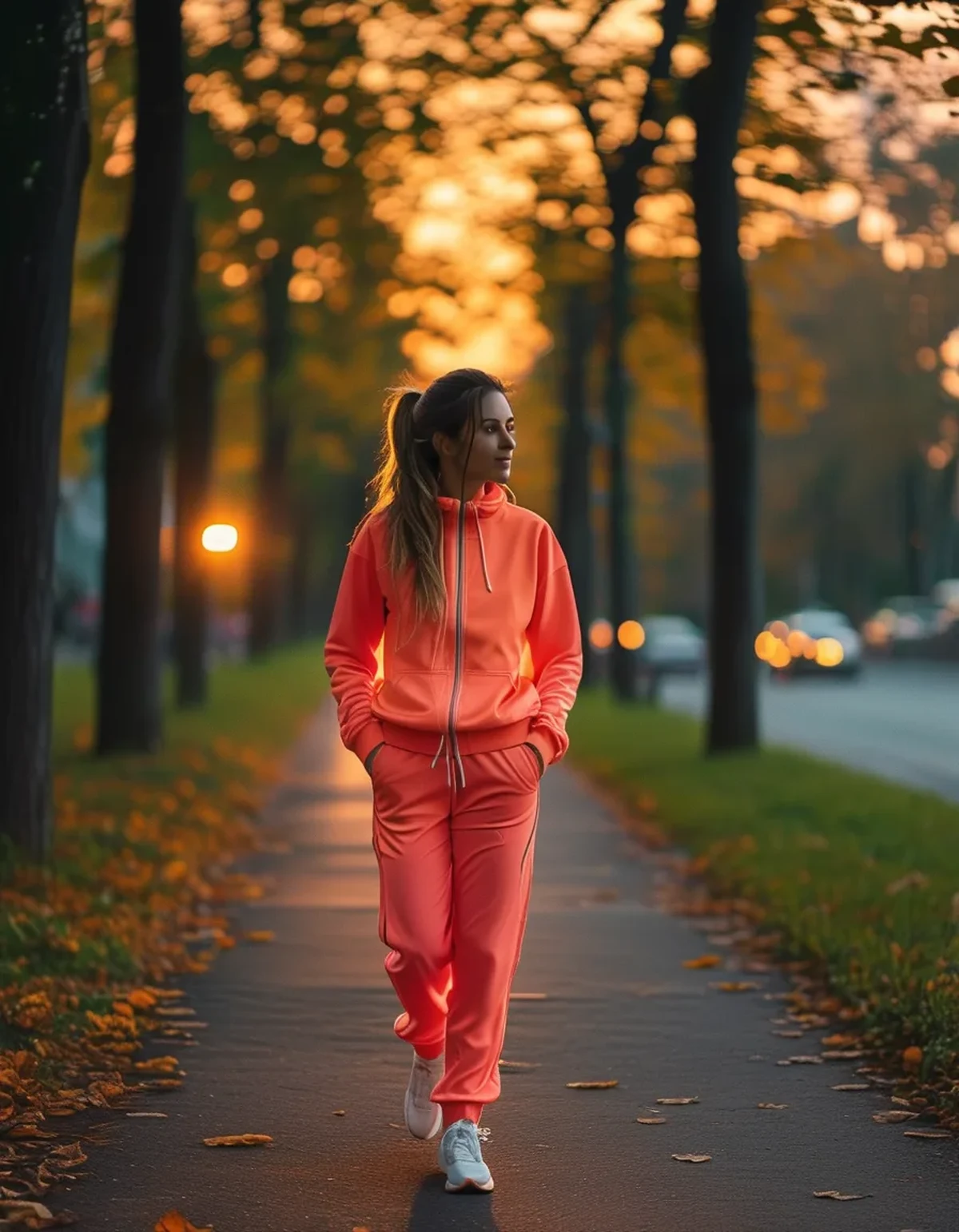
Building a kit that works across the whole transition
The awkward part of late August through October is that the same run can start in daylight and finish in near-dark.
For daylight and bright conditions:
- Any bright colour works. Contrast with the background is what matters, and the background changes - bright green disappears against summer foliage, and orange disappears against autumn leaves.
- Consider your route. Tree-lined paths in autumn make orange and yellow far less effective than blue or pink.
For dawn and dusk - the highest-risk window:
- Fluorescent yellow-green is the best-performing single colour, which is why it is used in safety standards
- Fluorescent orange and pink are close behind
- Add reflective detail now rather than at full dark, since the light is changing faster than you are noticing
For full dark:
- Reflective on ankles and wrists, non-negotiable
- A light, front and rear if on roads
- Colour is largely irrelevant - wear whatever you like
The transitional kit that covers everything, since most people do not want three outfits:
- Fluorescent yellow-green top with reflective detail built in
- Reflective ankle bands kept in a jacket pocket permanently - they weigh almost nothing
- Shoes with reflective panels, which you will buy anyway
- A clip-on blinking light
A note on black activewear, which is what most people own: it is the worst possible choice in low light and it is the default in nearly every wardrobe. You do not need to abandon it - adding reflective bands to black leggings gets you most of the way there, and it is far cheaper than replacing the kit.
Myth vs Fact: Being Seen in Low Light
Myth: White is the most visible colour at night. Fact: white performs reasonably against dark backgrounds and poorly against road surfaces, snow, and headlight glare, and it does not fluoresce. It significantly underperforms fluorescent yellow-green at dusk and both are beaten by reflective material after dark.
Myth: A reflective vest is enough. Fact: it is much better than nothing and worse than the same amount of reflective material on your limbs. A vest reads as a bright shape; moving limbs read as a person, and drivers respond much faster to the second.
Myth: If I can see the car, the driver can see me. Fact: this is the most dangerous assumption there is. Headlights are visible from far further than a pedestrian is, particularly with oncoming glare, a dirty windscreen, or rain. Seeing a car tells you nothing about being seen.
Myth: Streetlights make visibility clothing unnecessary. Fact: street lighting creates alternating light and shadow, and a pedestrian moving between the two is genuinely harder to track than one in consistent darkness. Lit urban roads are not a safe environment to be dark-clothed on.
Myth: Reflective material lasts forever. Fact: retroreflective elements degrade with washing, abrasion, and UV. Check yours with a phone flash in a dark room - if it does not light up brightly, it is not doing its job. Most gear loses meaningful reflectivity over a couple of years of regular washing.
Myth: Fluorescent colours glow in the dark. Fact: fluorescence requires UV light. Fluorescent kit does nothing after dark - it is a dawn, dusk, and overcast tool. Phosphorescent glow-in-the-dark material is a different thing entirely and fades within minutes.
FAQ: Low-Light Visibility Questions, Answered
What is the single best thing to buy?
Reflective ankle bands. Cheap, packable, work with any outfit, and they exploit the biomotion effect that makes you identifiable as a person at the greatest distance.
Is fluorescent or reflective better?
Different jobs. Fluorescent works in daylight, dawn, dusk, and overcast conditions and does nothing after dark. Reflective works wherever there is a light source pointed at you. In the transitional season you want both.
Does the colour of my leggings matter as much as my top?
For daylight, less - the torso is larger and higher in the field of view. For low light, the lower half matters more, because that is where the movement is.
How do I check whether my reflective gear still works?
In a dark room, hold a phone flash next to your eyes and look at the garment from a few metres away. Bright return means it is working. Dull grey means it has degraded.
Do I need lights if I run on pavements with streetlights?
A rear light is still worthwhile at crossings, driveways, and junctions, where drivers are turning and scanning. Lights matter most where there are no headlights to reflect - parks, towpaths, and unlit lanes.
TL;DR:
- Colour perception fades at dusk, so bright kit stops helping at exactly the busiest hour
- Fluorescent yellow-green is best for dawn, dusk, and overcast - and does nothing after full dark
- Retroreflective material on ankles and wrists beats a vest, because moving limbs read as a person
- Add a small blinking light where there are no headlights to reflect
- Check reflective gear with a phone flash - it degrades with washing and UV
As the evenings shorten over the next few weeks, the cheapest safety upgrade available is a pair of reflective ankle bands kept permanently in a jacket pocket. Keep the bright colours for the daylight half of the run and let the reflective detail handle the rest.
See It in Motion
Seen here: High Waist Yoga Leggings with Side Pockets — shop it on bubblelime.com
Keep Reading
This article is for general informational and styling purposes only. Fit, sizing, and product availability may vary.