Can You Wear Two Bright Colours at Once? The Rule That Makes It Work

Quick Answer: Two brights work when they differ in saturation weight - one dominant, one supporting - rather than competing at equal volume. The simplest reliable version is the 70/30 split: one bright takes the larger area, the second appears in a smaller piece or accessory. If both pieces are equally large and equally saturated, they need to sit far apart on the colour wheel to read as intentional colour blocking rather than accidental clash.
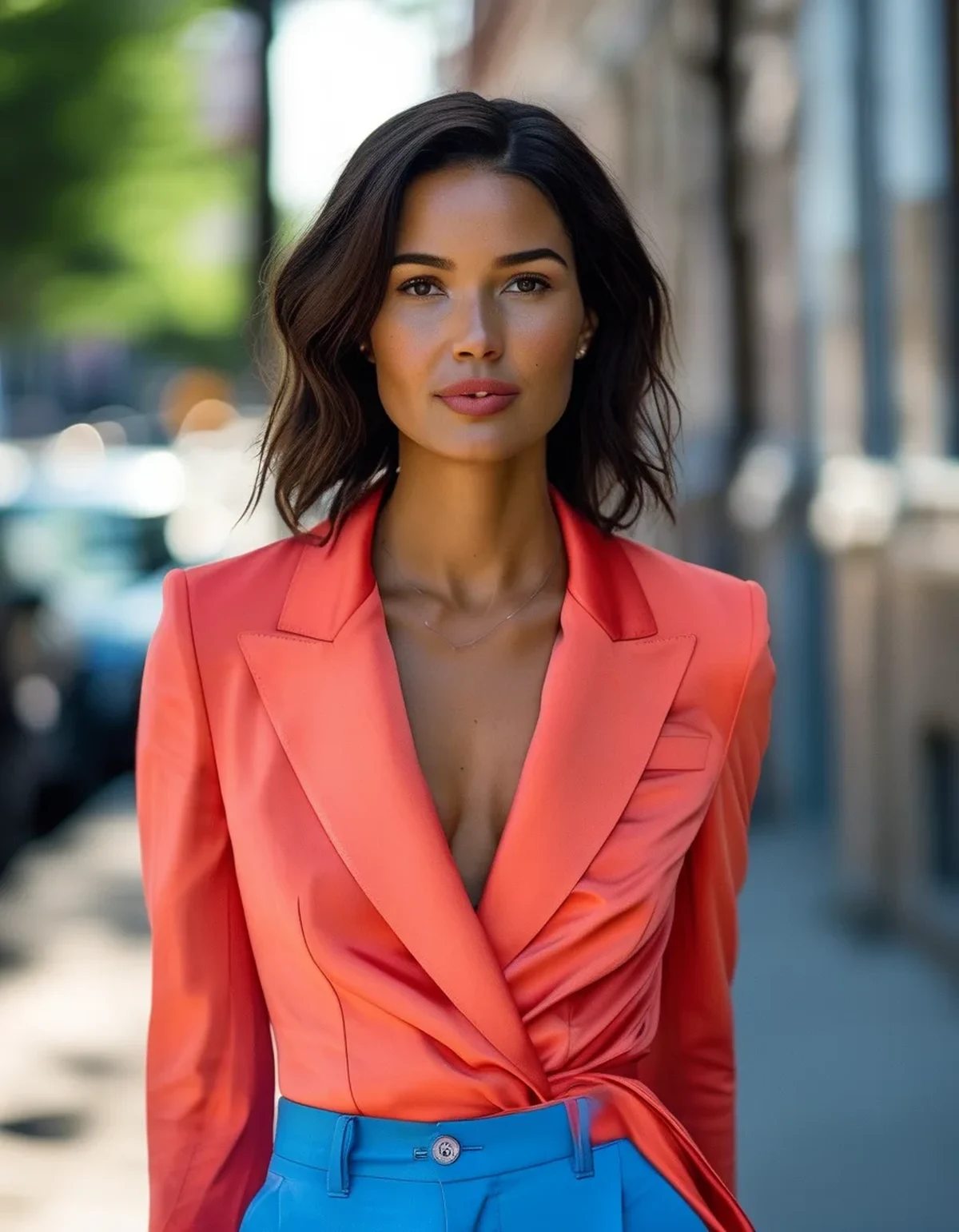
The worry is always the same. You hold up the coral and the cobalt, they look great separately, and something tells you the combination will be too much. Sometimes it will be. The variable deciding it is not the colours themselves.
Why does one bright feel safe and two feel risky?
Because a single bright has a supporting cast. Put a fuchsia top with black leggings and the black is doing something specific: it absorbs visual weight so the fuchsia is unambiguously the focal point. Your eye knows where to land.
Two brights of equal intensity, in equal amounts, remove the focal point. The eye bounces. That bouncing is what people register as too much - not the brightness, but the absence of a hierarchy.
Which means the fix is not muting anything. It is deciding which colour is in charge.
Three ways to build hierarchy:
- Area - one colour covers more of you than the other
- Saturation - one is at full intensity, the other slightly softened
- Position - the dominant colour sits closer to your face, where attention already goes
Get any one of these right and two brights read as a decision.
What is the 70/30 rule and how do you apply it?
Roughly 70 percent of the visible outfit in one bright, 30 percent in the second. The proportions do not need measuring - the point is that the split is obvious.
Versions that work:
- Bright leggings, bright accessory. Cobalt bottoms, neutral top, coral jacket tied at the waist or a coral cap. The second bright appears once and small.
- Bright top, bright shoe. Full-intensity top, neutral bottom, bright trainer picking up a second colour. This is the easiest entry point because the two brights are far apart on the body.
- Bright base, bright stripe. Anything with the second colour built into a trim, waistband, or side panel is doing the 30 percent for you.
What breaks it: a bright top and bright bottoms in similar amounts and similar intensity. That is a 50/50, and 50/50 needs the colours to be genuinely distant on the wheel - true complements or near-complements - to read as deliberate colour blocking.
The distance question
Colours close together on the wheel (coral and red-orange, teal and green) at high saturation tend to look like a mistake, because the eye reads them as an attempt at matching that missed. Colours far apart (cobalt and coral, fuchsia and lime) read as a choice. When in doubt, go further apart, not closer.

How does daylight change the answer this time of year?
It genuinely does, and it is why a combination you loved in July can look off in September.
Summer light is high, bright, and relatively cool at midday. Late-summer and autumn light is lower in the sky and warmer, and it shifts every colour it lands on. Warm-leaning brights - coral, tangerine, marigold, warm pink - get richer and more flattering. Cool brights with a blue base - icy turquoise, cool lime, electric periwinkle - can look slightly chalky and thin against warmer light and warmer surroundings.
Practical adjustments as the season turns:
- Lead with the warmer of your two brights - make that the 70 percent
- Swap a stark white neutral for cream, camel, or oatmeal, which sit better with warm light
- Bring the second bright closer to your face, since lower light means less overall brightness reaching it
- Watch for anything neon and cool-based; those read as summer more than any other colour family
This is also why the outfit that photographed brilliantly on a July beach looks different on an October pavement. The clothes did not change.
5 Mistakes Everyone Makes With Two Brights
Mistake 1: Matching the two brights to each other exactly. Two pieces in the same tone of the same colour family read as a set, which pulls the outfit toward uniform. If both are the same colour, one should be a different depth.
Mistake 2: Adding a third bright to balance. Three equal brights do not resolve a hierarchy problem; they compound it. If two feel unbalanced, remove one or shrink one - do not add.
Mistake 3: Forgetting the shoes count. A bright white trainer is a third colour with high visual weight. So is a bright bag. Count everything visible, not just the clothes.
Mistake 4: Testing it in warm indoor light. Bathroom and bedroom bulbs are warm and dim; they compress the difference between two saturated colours. Check in daylight near a window before committing, because outside is where the combination will be seen.
Mistake 5: Choosing brights that both fight your undertone. If a colour looks slightly draining on you alone, pairing it with a second bright does not rescue it - it doubles the exposure. Put the one that suits you nearest your face and let the less flattering one live below the waist.
FAQ: Wearing Two Bright Colours, Answered
Does black count as a neutral between two brights?
Yes, and it is the strongest separator available. A black layer between a bright top and bright bottoms breaks them into two separate statements rather than one collision. Navy, charcoal, and cream do the same job more softly.
Which two brights are the most reliably wearable pair?
Cobalt and coral is unusually forgiving - far apart on the wheel, both flattering across a wide range of skin tones, and neither reads as costume. Fuchsia with a warm orange is the next most reliable, though it is a bolder look.
Can I do two brights for the office?
Usually only with a strong 70/30 split and a structured piece somewhere. A bright blouse with a small bright accessory under a neutral blazer reads as considered. Two large blocks of bright colour reads as weekend regardless of the fabric.
What if I only own brights in activewear?
That is the easiest place to do this, actually, because activewear is already expected to carry colour. Use a bright legging as your 70 percent, a neutral top, and let a bright jacket or shoe supply the 30. It looks deliberate rather than loud.
TL;DR:
- Two brights fail when they compete at equal size and equal intensity - the problem is missing hierarchy, not brightness.
- Use the 70/30 split: one colour dominates by area, the second appears once and small.
- If you must go 50/50, put the colours far apart on the wheel so it reads as colour blocking.
- Warm brights lead as the season’s light warms. Swap stark white neutrals for cream or camel.
- Count the shoes and bag as colours, and check the whole thing in daylight before you leave.
Bright colour is not the risky part. Undecided colour is. Pick which one is in charge, give it the larger share, and the second bright stops being a gamble.
See It in Motion
Seen here: High Waist Yoga Leggings with Side Pockets — shop it on bubblelime.com
Keep Reading
This article is for general informational and styling purposes only. Fit, sizing, and product availability may vary.